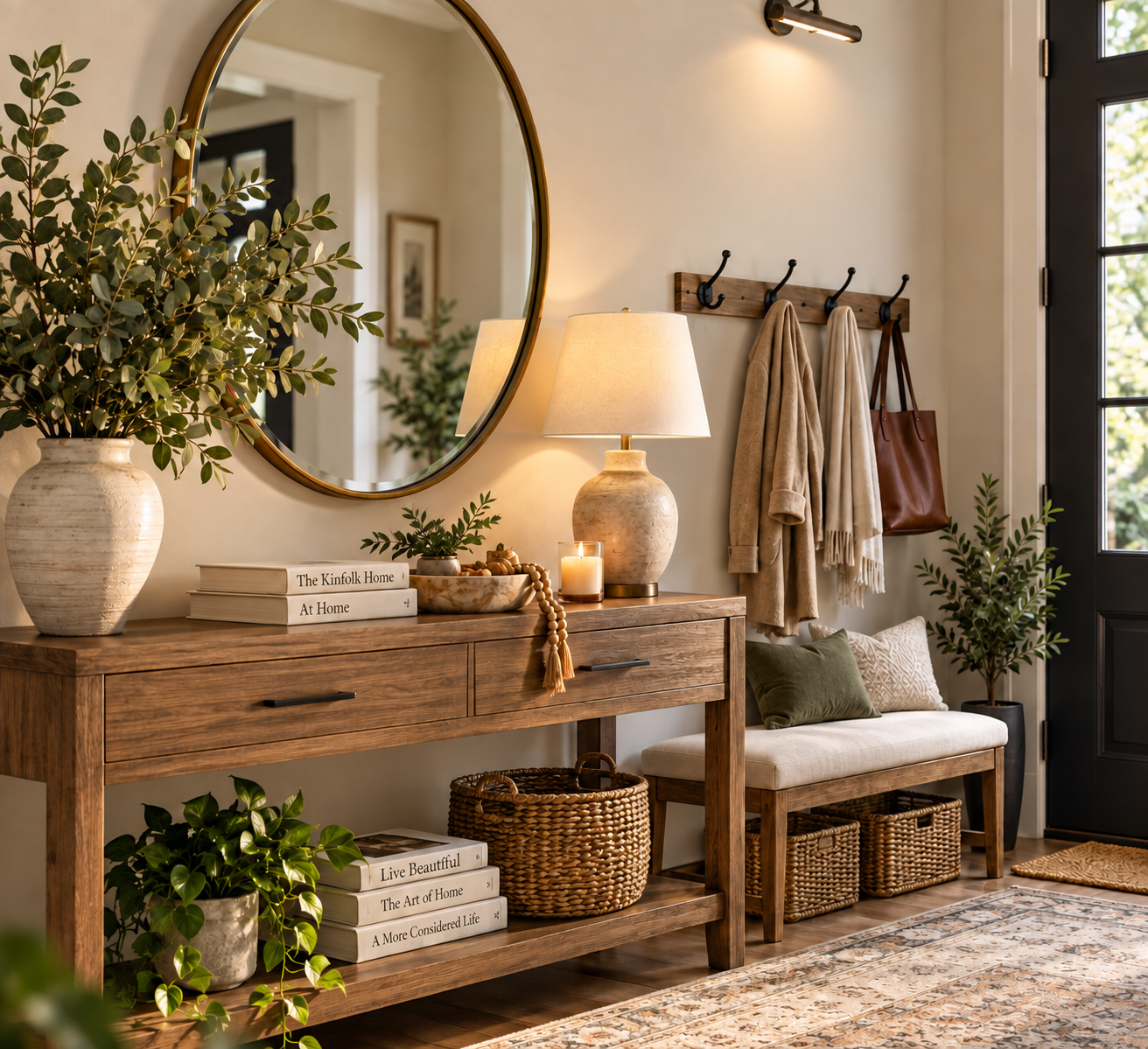
Entryway Furniture Ideas:
How to Create a Functional Entryway That Works Every Day
An entryway has to accomplish an unusual amount of work in a very small part of the home. It welcomes guests, catches shoes and bags, handles keys and mail, provides a last-minute checkpoint before you leave, and often becomes the first place clutter appears when you return. The best entryway furniture ideas therefore begin with more than deciding which table or bench looks attractive. They begin with understanding how the entrance needs to work for the people who use it every day. At My Home Treasure Trove, furniture and home décor can help you create that balance between practical organization and personal style, but the smartest starting point is deciding exactly what your entryway needs to accomplish.
A beautiful entrance that cannot handle everyday life will rarely stay beautiful for long. Shoes accumulate beside the door. Keys disappear under mail. Handbags end up on chairs. Dog leashes migrate to the kitchen counter. A decorative table slowly becomes a collection point for everything no one knows where to put.
That is why an effective entryway should be planned from the inside out.
Instead of buying several pieces and trying to make them work together afterward, identify the problems first. Look at how people move through the space, what they carry, what they remove when they arrive home, what they need when they leave, and which types of clutter repeatedly gather near the door.
Once those answers are clear, choosing furniture becomes much easier.
This guide walks through the process from measuring and planning to selecting tables, benches, shoe storage, and decorative elements so you can create an entrance that feels welcoming without sacrificing the function a real household needs.
Start With Your Habits Before You Start With Furniture
Before measuring a console table or looking for a bench, watch what actually happens near your door.
Your household is already giving you clues about the entryway it needs.
When someone walks through the door, what happens next?
Perhaps shoes are removed immediately. Maybe keys are placed on the nearest available surface. A handbag goes over a chair. Children’s backpacks land on the floor. Mail gets carried into the kitchen. The dog’s leash is hung over the doorknob because there is nowhere else to put it.
These habits matter because an entryway works best when its organization system follows natural behavior rather than constantly fighting it.
Spend a few days noticing the items that pass through the entrance most often.
You may discover that your entryway primarily needs to manage:
- Shoes and boots
- Coats and jackets
- Handbags and backpacks
- Keys, wallets, and sunglasses
- Mail and small packages
- Pet leashes and walking supplies
- Hats, scarves, and gloves
- Umbrellas
- Shopping bags
- Items waiting to leave the house
You do not necessarily need furniture for every category. The objective is to identify the recurring problems.
If your family never removes shoes at the front door, a large shoe-storage system may consume space without solving anything. If everyone needs a place to sit while putting on footwear, however, a bench may be far more valuable than a decorative console.
The same principle applies to a formal foyer. You may have plenty of floor space but very little need for storage. In that situation, an attractive table, mirror, and carefully chosen decorative arrangement might provide the right combination of function and presentation.
The room should reflect your household rather than an idealized photograph of someone else’s home.
Measure the Entryway Before Choosing Anything
One of the easiest ways to make an entrance feel cramped is to choose furniture based only on the dimensions of an empty wall.
An available wall is not necessarily available floor space.
Doors need to open. People need to walk through. Drawers and cabinet doors need room to operate. Packages may need to pass through the entrance. Pets may gather around the door. Several family members may enter at once.
Begin by measuring the complete area.
Record:
- Wall widths
- Distance between doorways
- Door-swing direction
- Available furniture depth
- Ceiling height if considering taller furniture
- Locations of vents, outlets, and switches
- Baseboards or trim that affect furniture placement
- Nearby stairways or hallways
- Areas that need to remain unobstructed
Then pay attention to movement.
Imagine carrying groceries through the door. Picture two people arriving home simultaneously. Think about winter coats, school bags, or a large package.
Would a deep table force everyone to turn sideways?
Would an open cabinet door block the walkway?
Could a bench interfere with the front door?
Would a coat rack create a bottleneck once bulky coats are hanging from it?
A useful trick is to mark the footprint of prospective furniture on the floor with removable painter’s tape. This gives you a much more realistic sense of depth than reading measurements online.
Walk around the taped area several times.
Open the door fully.
Carry a bag through the space.
Sit where the bench would be.
The goal is not simply to determine whether furniture physically fits. It is to determine whether the entrance still functions comfortably once that furniture is there.
Decide Which Jobs Your Entryway Needs to Perform
After observing your household and measuring the space, define the jobs the room must perform.
Most entryways need some combination of four basic functions: a landing surface, storage, seating, and visual welcome.
Your home may need all four or only one or two.
A Landing Surface
This is the place for items that need to be set down temporarily.
Keys, sunglasses, wallets, and outgoing mail are common examples.
A console or accent table can handle this role well, particularly if it includes a drawer or allows a small tray to keep loose objects contained.
Storage
Storage needs vary dramatically.
Some households require space for several pairs of everyday shoes, backpacks, winter accessories, and pet supplies. Others simply need somewhere to keep one umbrella and a set of keys.
The amount of storage should reflect the items that genuinely belong near the door rather than becoming an excuse to store everything there.
Seating
A bench, stool, or chair can be particularly helpful when people regularly change shoes near the entrance.
Seating can also make an entryway more comfortable for guests, children, or anyone who benefits from sitting while preparing to go outside.
A Visual Welcome
The entrance introduces the rest of the home.
A mirror, artwork, rug, vase, or other decorative accessory can bring personality into the space without interfering with its practical purpose.
Function and decoration do not have to compete. The strongest rooms allow each to support the other.
Entryway Console Tables: Useful When You Need a Landing Zone
A console or slim accent table is one of the most flexible pieces of entryway furniture because it provides function without necessarily requiring a large footprint.
It works especially well when the main problem is small-item clutter.
Instead of placing keys on the kitchen counter, mail on a chair, and sunglasses wherever they happen to land, one surface becomes the designated arrival and departure point.
Before choosing a table, think about what will actually live on it.
If you only need a small tray for keys and perhaps a lamp, a simple narrow design may be sufficient.
If paperwork repeatedly gathers near the door, drawers may be useful.
If bags or baskets need to fit underneath, pay attention to the height and structure below the tabletop.
Avoid selecting a table solely because it fills the wall beautifully. An oversized piece can make a narrow entrance feel obstructed, while a very small one may not provide enough usable surface area.
Think about the table as part of a system.
The top might contain a tray for keys, a small lamp, and one decorative object. A mirror can occupy the wall above it. Baskets underneath can hold selected everyday items if the design allows.
That combination creates both visual structure and a practical drop zone.
The key is restraint.
An entryway table covered with frames, bowls, candles, books, plants, mail, and seasonal decorations may look attractive immediately after styling, but it leaves little room for the objects that actually need to land there.
Give practical life some space.
Entryway Benches: Seating That Can Work Harder
A bench is often the right starting point when shoes are a major part of the entryway routine.
It gives people somewhere to sit, helps define the entrance visually, and may provide storage above, below, or inside the piece depending on its design.
Before choosing a bench, ask how it will be used.
Will adults sit on it every day?
Will children use it to put on shoes?
Will bags be placed there temporarily?
Do you want footwear stored below it?
Does it need concealed storage for seasonal accessories?
The answers help determine whether you need a simple open bench or a more storage-oriented piece.
In smaller entrances, multi-purpose furniture can be particularly helpful because one footprint serves more than one need.
Be careful, however, not to turn the bench into another permanent pile.
A bench that becomes the designated location for handbags, laundry, packages, and unopened boxes eventually stops functioning as seating.
Give the surface a clear purpose and create another home for objects that tend to accumulate there.
Shoe Storage: Solve the Problem at Floor Level
Shoes have a way of making even a thoughtfully decorated entrance look disorganized.
The answer is not necessarily hiding every pair.
It is deciding how many pairs realistically need to stay near the door.
Start by separating everyday footwear from occasional footwear.
The boots worn once a month do not necessarily need prime entryway space. Neither do formal shoes or out-of-season sandals.
Keep the most frequently used pairs accessible and move the rest to bedroom or closet storage when possible.
A shoe rack works well when visibility and easy access matter. Open storage makes it simple to return shoes to their place, which can be especially useful in busy households.
Closed storage creates a quieter visual appearance but requires people to open and close doors or drawers each time.
Neither approach is automatically better.
Choose the system your household is most likely to maintain.
Also think beyond capacity.
A shoe rack that technically holds many pairs may not be suitable if it projects too far into a narrow hallway. A taller unit may provide more storage without consuming as much floor area, but its scale still needs to suit the room.
The most effective shoe system is not necessarily the one with the greatest capacity.
It is the one that keeps the amount of footwear your household actually uses under control.
Coat Racks, Hooks, and Vertical Storage
When floor space is limited, walls become valuable.
Coat racks, hooks, and vertical storage can manage items that would otherwise occupy chairs, benches, or nearby rooms.
The same habit-first principle still applies.
If everyone enters through the same door carrying a coat and a bag, give those items obvious places to go.
If children use the entrance, consider whether storage locations are realistically accessible to them rather than expecting every item to be placed at adult height.
If you have a large coat closet only a few steps away, the entryway may need hooks for temporary everyday use rather than permanent storage for every jacket in the household.
Avoid turning vertical storage into visual overload.
A wall covered with hooks can still look chaotic if every hook carries multiple items.
Use the entryway for what is currently in rotation. Store off-season coats, rarely used bags, and excess accessories somewhere else.
Good entryway organization does not mean squeezing as much storage as possible beside the door.
It means keeping the right things there.
Bench or Console Table: Which Is Better for Your Entryway?
One of the most useful entryway decisions is also one of the simplest:
Do you need somewhere to sit, or somewhere to set things down?
Choose a bench first when your primary needs are:
- Sitting to put on or remove shoes
- Keeping everyday footwear nearby
- Giving children a practical place to get ready
- Adding storage close to floor level
- Creating a defined stopping point immediately inside the entrance
Choose a console table first when your primary needs are:
- Keys and wallets
- Sunglasses
- Small handbags
- Decorative lighting
- A mirror-and-table arrangement
- A narrow landing zone that does not require seating
If space permits, you can use both.
But a smaller entryway usually benefits from choosing the piece that solves the more important problem rather than forcing two pieces into a space designed for one.
Ask yourself:
What problem annoys us most when we walk through this door?
If the answer is, “There is nowhere to sit and shoes are everywhere,” start with the bench.
If the answer is, “We can never find the keys and mail covers the kitchen counter,” start with the table.
Furniture should earn its place by solving a recognizable problem.
Entryway Furniture Ideas for Different Types of Spaces
There is no single ideal entryway arrangement because entrances vary enormously. A narrow hallway, apartment doorway, and large foyer require different solutions.
Small Entryway
A small entrance needs discipline more than it needs a lot of furniture.
Choose one primary piece.
That might be a slim table, compact bench, or vertical storage solution.
Then let the wall provide additional function with a mirror, a small shelf, or a limited number of hooks if needed.
Avoid filling every available corner simply because something technically fits.
An open area of floor is valuable. It makes the entrance easier to navigate and visually calmer.
Prioritize the one or two problems the room truly needs to solve.
For example, a narrow table with a drawer and mirror may be enough for a household that stores shoes and coats elsewhere.
Another home may benefit more from a compact bench and wall hooks.
Small-space design works best when each element has a clear reason for being there.
Narrow Hallway Entryway
Depth matters more than width in many narrow entrances.
A long piece can work beautifully against a wall as long as it does not project too far into the walking path.
Look at furniture from the side, not just the front.
A console may appear appropriately sized based on width, but its depth could still interfere with movement.
Keep decorative accessories relatively shallow as well. A large vase extending toward the walkway can make a slim table less practical.
Mirrors and wall décor can provide visual interest without consuming floor space.
If storage is necessary, look for pieces that use vertical space rather than spreading outward.
Open-Concept Home Without a Defined Foyer
Some homes open almost immediately into a living room or dining area.
Instead of treating that as a design problem, create a visual boundary.
A console table can help establish where the entry zone begins and ends.
A rug may visually define the area.
A bench can create a deliberate place for arrival rather than allowing shoes and bags to migrate into the main room.
A mirror or artwork can give the entrance its own focal point.
The objective is not to construct a wall with furniture. It is to communicate that this small portion of the open room has a particular purpose.
Keep the entryway’s colors and finishes connected to the adjacent room so the new zone feels intentional rather than isolated.
Family Entryway
A household with several people usually needs more organization than decoration.
That does not mean the entrance cannot look attractive. It means the design should make daily routines easier first.
Think in categories.
Where do backpacks go?
Where are frequently worn shoes kept?
Where do keys land?
Where does the dog leash belong?
Where do hats and gloves go in cold weather?
Does each family member need a separate basket or hook?
The more frequently an item is used, the easier its storage location should be to reach.
Complicated organization systems tend to break down during rushed mornings.
An open basket someone can use in two seconds may prove more effective than a beautiful box with a lid that needs to be removed every time.
Family organization should make the desired habit easier than leaving the item on the floor.
Formal Foyer
A larger foyer offers more freedom, but more space does not require more furniture.
Begin with one anchor piece such as an entry table, console, or substantial bench.
Then build around it.
A mirror can introduce height and function. Artwork can create a focal point. An area rug can define the zone. Decorative objects can connect the entrance with the style found throughout the rest of the home.
If the foyer has generous dimensions, consider how the furniture appears from several directions. Large entryways are often visible from adjoining rooms, stairways, or hallways, so proportion becomes especially important.
The temptation is to fill the area.
Resist it.
A well-proportioned piece surrounded by appropriate open space can make the room feel much more intentional than several unrelated objects scattered around it.
Pet-Friendly Entryway
Pets introduce their own entryway requirements.
Leashes, harnesses, towels, waste bags, and walking accessories can quickly become clutter if they have no assigned location.
Create one compact pet station rather than spreading supplies around the room.
A basket can contain walking essentials. A hook can hold the everyday leash. Towels can be stored nearby if muddy paws are a regular issue.
Keep anything unsafe for pets securely out of reach, and make sure furniture does not create tight passageways around the door where excited animals and people compete for space.
Practicality matters more than creating a picture-perfect display.
Decorating an Entryway Without Losing the Function
Once the functional pieces are in place, decoration becomes much easier.
The best entryway décor supports the furniture rather than competing with it.
Begin with a focal point.
Over a console table, that might be a mirror or piece of wall art.
A mirror has the additional benefit of being useful when you are heading out the door. It can also reflect existing light and add visual depth.
Then consider the tabletop.
Instead of filling the entire surface, create a simple arrangement.
You might use a lamp, a decorative bowl or tray, and one additional accent such as a vase or sculptural object.
Leave usable surface area open.
That open space is not unfinished. It is what allows the table to perform its practical role.
If the entrance has a bench, keep accessories controlled. One or two pillows may provide softness, but too many make the seat inconvenient to use.
Rugs can add color, pattern, and texture while helping define the entry zone. Choose the size based on the room and door movement, making sure the door can operate freely over or beside the rug.
Wall décor should relate to the furniture below it rather than appearing to float independently.
The goal is cohesion.
When storage furniture, décor, lighting, and accessories relate to one another, even a modest entrance can feel considered and complete.
Create a Color and Material Connection With the Rest of the Home
An entryway is an introduction, not an isolated room.
Use it to provide a visual clue about what comes next.
You do not need to duplicate your living room or dining room exactly, but repeating one or two elements can create continuity.
Perhaps the warm wood tone of an entry table relates to nearby furniture.
Maybe a black mirror frame echoes hardware in another room.
A rug might pick up a muted version of a color used in the living area.
Metal finishes can repeat in lighting or decorative objects.
This is particularly important in open-concept homes where the entry is visible from adjoining spaces.
Avoid trying to introduce every design idea at the front door.
A strong entrance often uses a limited group of materials and colors.
Think in layers.
Start with the furniture.
Add a practical textile such as a rug or bench cushion.
Choose wall décor or a mirror.
Finish with a small number of decorative objects.
Each layer should contribute something different without overwhelming the previous one.
Plan for the Seasons You Actually Experience
An entryway that works beautifully in summer may struggle once cold or wet weather arrives.
Think beyond how the room looks today.
If your household regularly deals with snow, rain, or mud, decide where wet footwear will go before bad weather arrives.
If coats become much bulkier during cold months, make sure hanging storage can handle the seasonal change.
Scarves, gloves, and hats need accessible homes that do not require creating a new pile every day.
During warmer months, some of that storage can be reassigned or cleared.
This is a good reason not to permanently fill every basket and hook.
Your entryway needs breathing room for seasonal changes.
A periodic reset can keep the space from accumulating months of objects that are no longer in active use.
Lighting Matters in an Entryway
Entryways often need to function early in the morning, after dark, and during gloomy weather.
Lighting therefore deserves practical attention.
Overhead lighting provides general visibility, while a lamp on an entry table can add softer illumination and make the space feel more welcoming.
If your entry has limited natural light, a mirror can help reflect the light already available.
Consider where switches and outlets are located before positioning furniture.
A beautiful console table that blocks easy access to an outlet or switch may create unnecessary inconvenience.
Also think about what you actually do in the room.
Can you see well enough to find keys?
Can you check a bag before leaving?
Can you safely navigate shoes, rugs, and furniture at night?
Good entryway lighting is as much about usability as atmosphere.
Common Entryway Furniture Mistakes
Mistake 1: Buying Furniture Before Measuring
A piece can look narrow in a photograph and still be too deep for your hallway.
Better approach: Measure the room, door swing, and walkway first. Mark the furniture footprint before purchasing.
Mistake 2: Trying to Store Too Much
An entryway can quickly become overflow storage for the entire house.
Better approach: Reserve prime entryway space for items used during arrival and departure. Move occasional items elsewhere.
Mistake 3: Choosing Decoration Before Function
A beautifully styled table does not solve piles of shoes.
Better approach: Identify the household’s biggest entryway problem first, then choose the furniture that addresses it.
Mistake 4: Filling Every Wall
Empty space is not wasted space.
Better approach: Preserve room for movement. One correctly sized piece can accomplish more than several smaller pieces crowding a narrow area.
Mistake 5: Ignoring Door Movement
Doors, drawers, and cabinets all require clearance.
Better approach: Test how every moving part will function before finalizing the layout.
Mistake 6: Creating an Organization System That Is Too Complicated
If putting away a frequently used item requires opening several containers, moving another object, and reaching into a difficult corner, people are less likely to maintain the system.
Better approach: Make storage easier than creating clutter.
Mistake 7: Treating the Entryway Like a Permanent Display
Rooms change because households change.
Better approach: Allow storage to adapt to weather, school schedules, pets, work routines, and seasonal clothing.
Mistake 8: Forgetting Furniture Stability
Tall or top-heavy furniture may require additional stability measures.
Better approach: Follow all manufacturer assembly, installation, and anchoring instructions, especially for taller storage pieces.
How to Furnish an Entryway on a Budget
A functional entrance does not require purchasing an entire matching collection.
Start with the problem that creates the most daily frustration.
If shoes are the issue, solve shoe storage first.
If there is nowhere to put keys and mail, prioritize a table.
If people struggle to put on footwear comfortably, begin with seating.
The second piece should complement the first rather than duplicate its role.
You can also make a modest furniture arrangement feel more complete through supporting elements such as a tray, basket, mirror, rug, or wall décor.
Spend where function matters.
A piece of furniture used several times every day deserves careful attention to dimensions, construction, and usefulness.
Decorative details can be added gradually.
This approach also gives you time to live with the first piece and discover what the room still needs.
A Simple Entryway Planning Formula
If the number of possibilities feels overwhelming, use this order:
First: Observe.
Notice what people carry in and out and where clutter forms.
Second: Measure.
Record the space and protect comfortable movement.
Third: Prioritize.
Choose the one problem the entryway most needs to solve.
Fourth: Select the anchor piece.
Choose the table, bench, storage unit, or other primary piece that addresses that problem.
Fifth: Add only necessary storage.
Hooks, baskets, shoe storage, or shelving should have defined jobs.
Sixth: Add the visual layer.
Introduce a mirror, rug, art, lighting, and a small amount of décor.
Seventh: Live with it.
If clutter still forms in one location, ask what the space is telling you before buying anything else.
This process keeps the room focused.
Instead of asking, “What else can I put here?” ask, “What is still not working?”
That one change in thinking can prevent overfurnishing and make the final room much easier to maintain.
How to Keep the Entryway Organized After You Finish It
An entryway should be easy to reset.
If it requires a major cleaning session every week, the system is probably asking too much of the household.
Build a quick reset into normal routines.
Return extra shoes to their closets.
Process mail rather than allowing it to accumulate.
Move out-of-season clothing elsewhere.
Empty catch-all baskets before they become permanent storage.
Remove objects waiting to be taken somewhere as soon as that errand is completed.
Every few months, reassess the furniture itself.
Is the bench still solving the original problem?
Is the table constantly overcrowded?
Are baskets being used?
Has someone’s routine changed?
Good organization is not static.
A functional room can adjust as the household changes.
Frequently Asked Questions About Entryway Furniture
What Furniture Should You Put in an Entryway?
The most useful entryway furniture depends on the functions your household needs. Common options include a console or accent table for keys and mail, a bench for seating, shoe storage, coat storage, a storage cabinet, or an occasional chair in a larger foyer.
Start with the biggest everyday problem instead of trying to include every possible furniture type.
Is a Bench or Console Table Better for an Entryway?
A bench is generally more useful when seating and shoe management are priorities. A console table is better when you need a narrow landing surface for keys, mail, wallets, and similar items.
If your room is small, select the piece that addresses your most frequent need instead of squeezing both into the space.
How Do I Furnish a Very Small Entryway?
Begin by protecting the walkway.
Choose one compact anchor piece, such as a narrow table or small bench, and use the wall for additional function where appropriate.
A mirror, wall décor, hooks, or a small shelf can add utility without using additional floor space.
Most importantly, limit what is stored there.
A small entrance works better when it handles everyday essentials rather than serving as storage for every coat, shoe, and bag in the household.
How Can I Create an Entryway if My Front Door Opens Into the Living Room?
Define the entrance visually instead of trying to construct a separate room.
A console table, bench, or rug can establish a boundary between the arrival zone and the rest of the living area.
Use colors or materials that relate to the adjacent room so the entry looks like part of the overall design.
Storage is especially important in this layout because clutter near the door is immediately visible from the living space.
How Do I Keep Shoes From Cluttering the Entryway?
Limit entryway shoe storage to footwear that is currently used frequently.
Give each pair an obvious location on a rack, under a bench, inside storage furniture, or in another designated solution.
Move occasional and out-of-season footwear elsewhere.
The problem is often not that a household lacks enough shoe storage. It may simply be that too many pairs are competing for the most convenient location.
How Should I Decorate an Entryway Table?
Start with function.
Reserve part of the tabletop for everyday needs, then add a limited decorative arrangement.
A mirror or artwork above the table can create a focal point. On the table itself, consider a lamp, catch-all tray, and one decorative accent.
Avoid covering the entire surface.
An entry table should still have room for the temporary objects it is meant to receive.
What Should Every Family Entryway Have?
There is no universal list, but most busy family entrances benefit from an obvious place for frequently used shoes, bags, keys, and outerwear.
Families may also benefit from seating and designated storage for each household member.
The best system is one everyone can use quickly and consistently.
How Do I Make an Entryway Look Welcoming Without Adding Clutter?
Focus on scale and a small number of intentional elements.
Choose furniture appropriate to the room, provide adequate lighting, add a mirror or artwork, introduce texture through a rug or basket, and leave some open space.
A room does not need many objects to feel finished.
In an entryway, visual breathing room can be just as important as decoration.
Build an Entryway Around Real Life
A successful entryway does not need to be large, formal, or filled with furniture. It needs to make arriving home and leaving again a little easier. Start by noticing your household’s routines, measure before adding furniture, prioritize the problems that occur most often, and give every major piece a clear job. From a practical bench to a slim accent table, shoe storage, a mirror, or a few carefully chosen decorative details, the right combination can create an entrance that feels organized without feeling rigid. When you’re ready to find furniture and décor that fit the way your home actually works, browse My Home Treasure Trove and find pieces that can help you create a welcoming entrance with both purpose and personality.