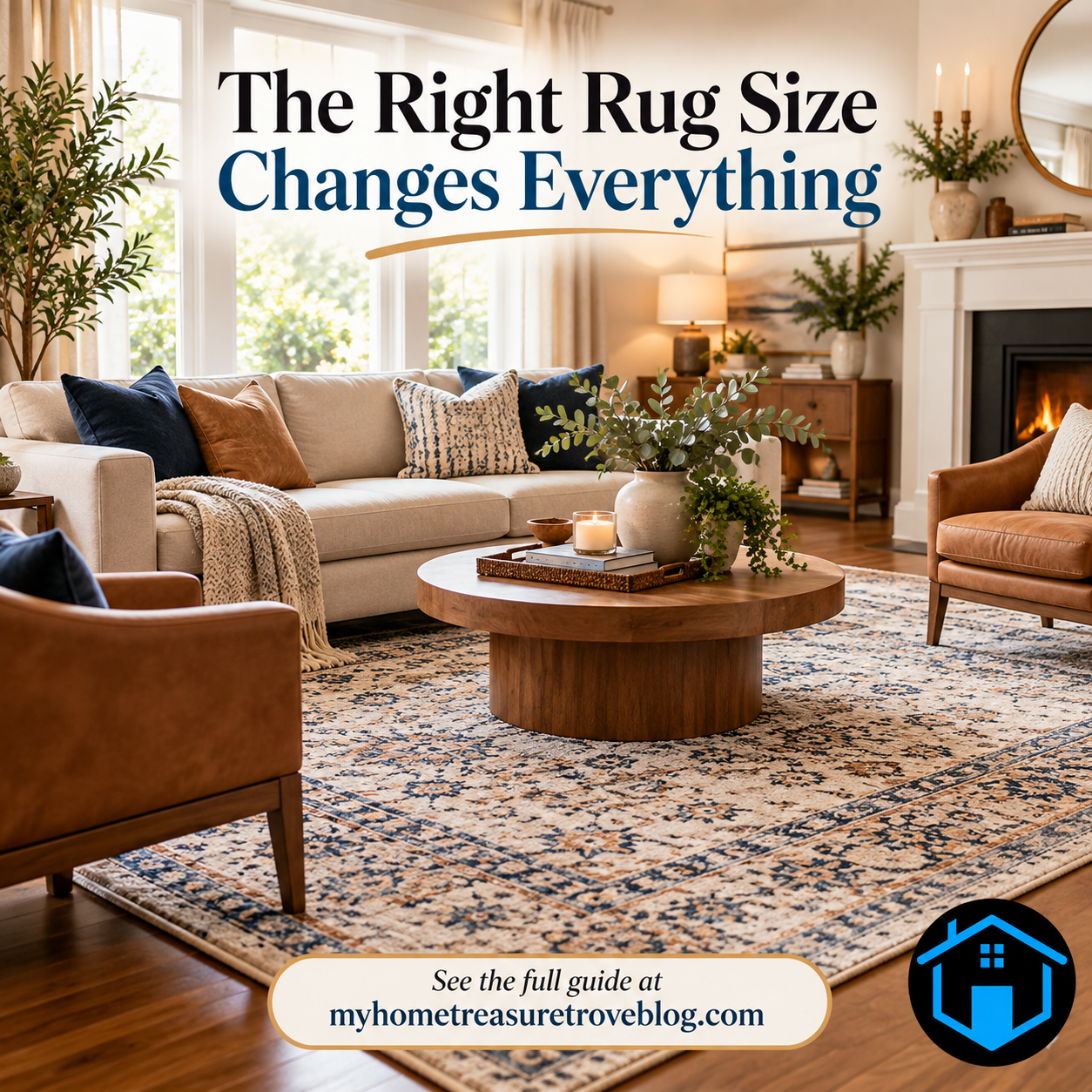
Area Rug Size Guide:
How to Choose the Right Rug for Every Room
A beautiful rug can have the right color, pattern, and texture and still look completely wrong once you put it on the floor. More often than not, the problem is not the rug itself—it’s the size. A rug that is too small can leave sofas and chairs looking disconnected, make a dining table appear to float in the room, or disappear almost entirely beneath a bed. A well-proportioned rug, on the other hand, helps furniture relate to one another and gives the room a clearer sense of structure. This area rug size guide will help you measure before buying, understand furniture placement, and choose a rug that fits the way your room actually works. As you plan your room, My Home Treasure Trove can also be a source of inspiration for coordinating furniture and home décor around the layout you create.
The most important idea to remember is surprisingly simple:
Choose the rug for the furniture arrangement, not for the empty floor.
That single shift in thinking solves many of the most common rug-sizing problems.
A living-room rug should visually connect the conversation area. A dining-room rug has to accommodate chairs as people pull them away from the table. A bedroom rug needs to relate to the bed rather than simply filling whatever floor area remains.
And although common measurements can be useful, they are guidelines rather than laws. Homes have different proportions, furniture sizes, doorways, traffic patterns, and floor plans.
That is why the best approach starts with measuring your actual room.
Let’s work through it step by step.
Why Area Rug Size Matters So Much
Rugs are often treated as decorative finishing touches.
In reality, they can influence the visual structure of an entire room.
Imagine a living room with a sofa, two chairs, and a coffee table. Now place a tiny rug only beneath the coffee table.
The rug may be attractive, but the sofa and chairs are visually outside the arrangement. The furniture can appear to be standing independently around a decorative island.
Now imagine a larger rug reaching underneath at least the front portion of each major seating piece.
Suddenly, the furniture feels related.
The rug has created a visual boundary around the conversation area.
That is why rug size matters.
An area rug can:
- Connect furniture pieces visually
- Define a seating or dining zone
- Add softness and texture
- Introduce color and pattern
- Separate functions in an open floor plan
- Add warmth beneath a bed
- Help establish scale in a large room
- Reduce the feeling of scattered furniture
But it can only perform those jobs effectively when its size relates to the furniture and room.
The same principle applies in smaller homes.
A larger rug does not necessarily make a small room feel more crowded. Sometimes the opposite happens. A rug that connects several pieces can create one clear furniture grouping instead of breaking the floor into several unrelated visual fragments.
The important thing is proportion.
The Biggest Rug Mistake: Choosing One That’s Too Small
One of the most common problems in rug placement is choosing a rug that is too small for the furniture arrangement.
Current rug-sizing guides consistently warn against undersizing and recommend selecting rugs that connect major pieces of furniture rather than floating independently in the center of a room.
Why does this happen so often?
Part of the problem is that rugs look deceptively large when you see them rolled, folded, hanging in a showroom, or displayed by themselves online.
A 5-by-8-foot rug sounds substantial.
Then you put it in a room with an 84-inch sofa, two chairs, a coffee table, and several feet of open floor, and it suddenly looks much smaller.
Another reason is cost.
Larger rugs generally represent a bigger purchase, so choosing the smaller available option can feel practical.
But a bargain is not especially helpful if the rug never looks right in the room.
This is why measuring before buying is so important.
Do not estimate with your eyes.
Measure.
Better still, outline the prospective rug dimensions on your floor before you place the order.
How to Measure for an Area Rug Before You Buy
You do not need complicated design software to determine whether a rug will fit.
You need:
- A tape measure
- Painter’s tape or another removable floor-safe tape
- Your furniture in approximately its intended position
- A few minutes to walk around the room and evaluate the footprint
Step 1: Arrange the Furniture First
Before measuring for the rug, determine where the major furniture pieces are supposed to go.
In a living room, position the sofa and chairs.
In a dining room, place the table where it will normally sit.
In a bedroom, position the bed and nightstands.
Why furniture first?
Because the rug is usually there to support the furniture grouping.
If you size the rug before deciding on the layout, you may end up arranging the furniture around the rug instead of choosing a rug that works for the room.
Step 2: Measure the Furniture Grouping
Do not measure only the empty floor.
Measure the width and length of the arrangement you want the rug to connect.
For example, in a living room, measure from one end of the seating group to the other.
In a dining room, begin with the table but remember that chairs move outward during use.
In a bedroom, measure the bed and decide how much rug you want visible around the sides and foot.
Step 3: Test Standard Rug Sizes
Once you know your target dimensions, compare them with commonly available rug sizes such as:
- 3 x 5 feet
- 4 x 6 feet
- 5 x 8 feet
- 6 x 9 feet
- 8 x 10 feet
- 9 x 12 feet
- 10 x 14 feet
- Runners in a variety of lengths
Exact availability varies, so think of these as familiar reference points rather than a complete list.
Step 4: Tape the Outline on the Floor
This is one of the most valuable steps.
Use painter’s tape to mark the outside dimensions of the rug you are considering.
Then walk around it.
Sit on the sofa.
Pull out the dining chairs.
Open the bedroom door.
Walk through nearby passageways.
Stand at the entrance to the room and look at the overall proportion.
A rug size that seemed ideal on paper may feel very different once you see the full footprint.
Room & Board and other current sizing guides similarly recommend evaluating the rug in relation to furniture and leaving an intentional amount of visible flooring rather than buying by dimensions alone.
Living Room Rug Size: Start With the Seating Arrangement
The living room is where rug placement tends to cause the most confusion because there are several valid arrangements.
You may have:
- A sofa and two chairs
- A sofa and loveseat
- A sectional
- Two sofas
- A compact apartment seating arrangement
- A large conversation area
- Multiple seating zones in one room
There is no single rug dimension that works for every living room.
Instead, choose between several furniture-placement approaches.
Option 1: Front Legs on the Rug
This is one of the most versatile living-room arrangements.
Place the rug so the front legs of the sofa and major chairs sit on it while the back legs remain on the floor.
This works particularly well when:
- The room is medium-sized
- Furniture is positioned partly against walls
- A larger rug would cover more floor than you want
- You want the seating arrangement to feel connected without putting every piece completely on the rug
The key is consistency.
If the sofa’s front legs are on the rug, try to connect the major chairs in the same general way rather than having one chair floating completely outside the arrangement.
Current rug-placement guidance frequently uses front-leg placement as a practical way to anchor living-room furniture.
Option 2: All Furniture Legs on the Rug
In a larger living room, you may choose a rug spacious enough for the sofa, chairs, and tables to sit completely on it.
This arrangement can create a generous, grounded look.
It works particularly well when furniture floats away from the walls.
Instead of the room reading as a collection of individual pieces, the rug creates a large visual platform for the entire conversation area.
Make sure the rug extends beyond the furniture rather than ending exactly beneath the legs.
You want the arrangement to look comfortably contained, not squeezed onto the rug like furniture on a raft.
Option 3: A Smaller Rug in a Compact Room
What if your living room is genuinely tiny?
You may not have enough floor space for a large rug beneath several pieces.
A smaller rug can still work when the arrangement is intentional.
For example, you might use a compact rug beneath a coffee table with seating positioned closely around it.
But be careful.
There is a difference between deliberately using an accent-size rug and buying a rug that is simply too small for a conventional furniture arrangement.
If the rug looks like it accidentally landed in the middle of a much larger room, increasing the size will often improve the overall balance.
What Size Rug Works With a Sofa?
Rather than choosing the rug based solely on sofa length, look at the sofa as part of the complete seating group.
Still, one visual principle is useful:
The rug should generally look substantial in relation to the sofa rather than noticeably narrower than it.
Some sizing guides recommend selecting a rug that extends beyond the sofa ends, helping the rug appear proportional rather than pinched beneath the furniture. Room & Board, for example, recommends roughly 8–12 inches of extension on each sofa side in certain smaller-room layouts.
Do not treat that as an absolute rule.
Use it as a visual check.
If your sofa overwhelms the rug, test the next size up.
What Size Rug Works With a Sectional?
Sectionals create larger furniture footprints, so they frequently require larger rugs.
First decide what you want the rug to connect.
If the sectional defines most of the conversation area, a rug can sit under the front legs while extending into the open portion of the seating arrangement.
In a larger room, a bigger rug can extend beneath the entire sectional and supporting chairs.
The important issue is not whether every sectional leg follows one universal placement rule.
It is whether the rug visually supports the sectional’s scale.
A tiny centered rug can look particularly disconnected when placed inside the large L-shape of a sectional.
Tape out several sizes before purchasing.
The difference between two rug dimensions can be dramatic.
Dining Room Rug Size: Plan for the Chairs, Not Just the Table
Dining-room rug sizing is one of the easiest concepts to understand once you remember one thing:
Your dining chairs move.
A rug may appear perfectly proportioned when every chair is tucked tightly beneath the table.
Then someone sits down.
The chair slides backward, catches the rug edge, and suddenly the arrangement is much less practical.
Your rug therefore needs to accommodate both the table and the movement of the chairs.
A commonly recommended starting point is approximately 24 inches of rug beyond the dining-table edge on each side, allowing chairs to remain on the rug as they move outward. Lowe’s and Room & Board both use roughly two feet of extension as a practical dining-room guideline.
Some rooms or larger chairs may benefit from more.
This is another reason the painter’s-tape test is helpful.
How to Measure a Dining Room Rug
Measure the table.
Then add the chair-clearance area around it.
For example, if you are considering roughly 24 inches of additional rug on every side, you would add about 48 inches to both the table length and width.
But do not order from the calculation alone.
Tape the resulting size on the floor and physically pull your dining chairs away from the table.
Make sure:
- The rear chair legs remain comfortably on the rug
- Chairs do not catch the rug edge
- The rug does not interfere with nearby cabinets
- Enough room remains for people to walk behind occupied chairs
- The rug fits the overall dining space rather than crowding it
Function comes first.
Round Dining Table: Round Rug or Rectangular Rug?
A round table does not automatically require a round rug.
Both round and rectangular rugs can work.
A round rug reinforces the shape of the table and can create a visually centered arrangement.
A rectangular rug can connect the dining area more strongly with the architecture of a rectangular room.
The critical issue remains size.
The rug must extend far enough beyond the table to accommodate the chairs.
Do not choose a small round rug that barely extends past the tabletop simply because the shapes match.
The furniture still needs room to function.
Extendable Dining Tables Need Extra Planning
If you regularly use an extension leaf, size the rug for the table when it is extended whenever practical.
Otherwise, you may create a dining arrangement that works beautifully for four people but becomes awkward every time you host six or eight.
Ask yourself how the room is actually used.
If the table is extended only once every few years, you may accept a compromise.
If holiday dinners, family gatherings, or regular entertaining are part of your routine, plan for the larger configuration from the beginning.
Real-life use should guide the decision.
Bedroom Rug Size: Think About Where Your Feet Land
A bedroom rug has a different job from a living-room rug.
It does not necessarily need to connect a conversation group.
Instead, it often adds:
- Softness beside the bed
- Visual weight beneath the bed
- Color or pattern
- Warmth
- A defined sleeping zone
The bed should usually determine the rug placement.
Rug Under the Lower Portion of the Bed
One popular layout places the rug beneath the lower portion of the bed while leaving the nightstands on the exposed floor.
The rug extends out from both sides and beyond the foot.
This gives you visible softness where you step while avoiding the need for an extremely large rug extending all the way beneath the headboard and nightstands.
Current bedroom guides commonly recommend allowing roughly 18–24 inches of rug to remain visible beyond the bed sides and foot when room proportions allow.
Again, use the measurement as guidance rather than law.
A very small bedroom may require less.
A large bedroom may look better with more generous coverage.
Large Rug Beneath the Entire Bed Arrangement
In a spacious bedroom, a large rug can extend beneath the entire bed and potentially the nightstands.
This creates a more substantial visual foundation.
Make sure enough rug remains visible around the furniture.
If nearly the entire rug disappears beneath the bed, you may be paying for a lot of material nobody sees while getting very little decorative impact.
Tape the dimensions before buying and evaluate how much visible rug will remain.
Runners or Small Rugs Beside the Bed
Sometimes a large area rug is unnecessary.
If you already have attractive flooring and mainly want a soft surface underfoot, runners or smaller rugs beside the bed can be a practical alternative.
This can work especially well in:
- Narrow bedrooms
- Guest rooms
- Rooms with unusual proportions
- Spaces where a large rug would interfere with doors or furniture
- Bedrooms where you want to preserve more visible flooring
Room & Board includes side rugs and runners among its suggested bedroom configurations, showing that full-bed coverage is not the only workable solution.
What Size Rug Under a Queen Bed?
An 8-by-10-foot rug is a commonly used starting point beneath a queen bed, particularly when the rug extends beyond the bed sides and foot.
But bed size alone should not make the decision.
Consider:
- Room width
- Nightstand placement
- Bench placement
- Door clearance
- How far the rug will extend at the foot
- Whether you want the nightstands on or off the rug
Tape the proposed dimensions before purchasing.
What Size Rug Under a King Bed?
King beds have considerable visual weight and usually need a more substantial rug.
A 9-by-12-foot rug is a common starting point, and some larger rooms may comfortably accommodate a 10-by-14-foot rug.
Again, the room matters.
A large rug squeezed almost wall-to-wall into a modest bedroom may not look as balanced as a slightly different placement.
Measure the actual bed, furniture, and floor area rather than relying on the mattress label alone.
Current guides commonly associate larger rugs such as 9-by-12 with king-bed layouts, though the recommended size varies with room and placement.
Area Rugs in Small Rooms: Bigger Can Sometimes Look Better
Many homeowners automatically choose a small rug for a small room.
That sounds logical.
But visual scale does not always work that way.
Several small areas of exposed floor around a tiny rug can visually chop the room into pieces.
A larger rug can create one stronger foundation.
Imagine a small living room.
A 5-by-8 rug floats under the coffee table, with the sofa and chairs sitting entirely outside it.
Now replace it with a rug that reaches beneath the front legs of the seating.
The physical room has not grown.
But the furniture now reads as one unified group.
That can make the room feel calmer and more coherent.
Of course, you still need visible breathing room.
Do not force a huge rug between walls simply because “bigger is better.”
Bigger is not automatically better.
Better proportion is better.
Open Floor Plans: Use Rugs to Create Rooms Without Walls
Open floor plans present an ideal opportunity for area rugs.
Without walls, it can be difficult to determine where one functional zone ends and another begins.
A rug can establish that boundary visually.
For example:
- One rug defines the living-room conversation area.
- Another defines the dining area.
- A runner marks a nearby passage.
- Furniture placement reinforces each boundary.
The rugs do not have to match exactly.
In fact, matching rugs across a large open space can sometimes make the arrangement feel overly coordinated.
Instead, look for a relationship.
They might share:
- A color
- Similar warmth
- Comparable texture
- A repeating pattern family
- Related neutral tones
But the sizes should respond independently to the furniture in each zone.
Do not buy two identical 8-by-10 rugs simply because the spaces are adjacent.
The living-room arrangement and dining-table footprint may require different dimensions.
Can You Use More Than One Rug in a Room?
Yes.
Multiple rugs can help define separate zones in a very large room.
For example, one side of a large living space might contain the primary sofa and television area while another has two chairs and a small table for conversation or reading.
Each group could potentially have its own rug.
But avoid turning the floor into a patchwork of unrelated islands.
The rugs should have enough visual connection that the room still feels cohesive.
If one rug is highly patterned, the second might be simpler.
If both have patterns, repeat at least one color or general design characteristic.
Size each rug for the furniture arrangement it supports.
Hallway and Runner Rug Size
Runner rugs work differently from large room rugs.
The goal is usually to create a long visual path while leaving some flooring visible around the edges.
Before choosing a runner, measure:
- Hallway width
- Hallway length
- Door swings
- Closets that open into the hallway
- Heat registers or floor vents
- Transition points into nearby rooms
Avoid assuming that the longest runner possible is automatically the best choice.
Some visible floor at the beginning and end can help the runner look deliberate rather than squeezed into the hall.
Also consider safety.
Make sure the rug lies flat, does not interfere with doors, and is used with an appropriate rug pad or other solution recommended for the rug and flooring involved.
Entryway Rugs: Measure the Door Swing First
An entryway rug may look ideal until the front door refuses to open over it.
Before selecting a rug for the entrance, check:
- Door clearance
- Rug thickness
- Width of the doorway
- Available walking area
- Furniture placement
- How wet or dirty footwear is handled
High-traffic entrances also need materials suited to the household.
A pale, delicate rug may not be the most practical choice for a busy doorway where rain, snow, pets, children, or muddy shoes are everyday realities.
The room’s function should influence both size and material.
Should a Rug Match the Shape of the Room?
Not necessarily.
A rectangular room can have a round rug.
A square room can have a rectangular rug.
A round table can sit on a rectangular rug.
Instead of matching the architecture automatically, ask what shape best supports the furniture arrangement.
Rectangular Rugs
These are highly versatile and work well with:
- Sofas
- Sectionals
- Beds
- Rectangular dining tables
- Large seating arrangements
Round Rugs
Round rugs can work particularly well:
- Beneath round tables
- In compact conversation areas
- In square rooms where you want to soften the geometry
- Beneath a centered accent table
Square Rugs
Square rugs can suit:
- Square rooms
- Square dining tables
- Symmetrical furniture arrangements
Runners
Runners are especially useful in:
- Hallways
- Kitchens
- Narrow passages
- Beside beds
Shape should support the room rather than becoming a rule by itself.
Leave Enough Visible Floor to Frame the Rug
An area rug generally benefits from some visible flooring around it.
That exposed floor acts like a frame.
If a rug stops only an inch or two from every wall, it may begin to look like carpet that does not quite fit.
Many rug guides use roughly 18 inches of visible flooring as a common starting point in larger rooms while allowing less in smaller spaces.
But once again, your room should make the final decision.
A narrow bedroom or small apartment living room may not have enough space for an 18-inch border.
Use proportion rather than forcing a number that clearly does not work.
The floor border should look intentional.
Do Not Forget Doors, Cabinets, and Traffic Paths
A rug does not exist only in relation to furniture.
People have to move through the room.
Before purchasing, check:
- Interior door swings
- Closet doors
- Cabinet doors
- Floor vents
- Fireplace hearths
- Walkways
- Stair openings
- Furniture drawers
- Reclining furniture
- Rolling desk chairs where applicable
This matters especially with thicker rugs.
A door that easily clears bare flooring may drag across a plush rug.
A dining cabinet may technically fit beside a large rug but feel awkward when someone needs to walk between the cabinet and occupied dining chairs.
Good room planning looks at movement, not simply photographs.
Choosing Rug Size for a Real Household
Interior-design images are useful for inspiration, but your house needs to work after the picture is taken.
That means asking practical questions.
Do You Have Children?
A larger living-room rug may provide more soft floor area for sitting and playing.
But consider maintenance and ease of cleaning too.
Do You Have Pets?
Think about shedding, muddy paws, traction, and how easily the rug can be cleaned.
Do You Frequently Entertain?
Dining-chair movement and traffic behind chairs become especially important.
Does Furniture Move Often?
If chairs are frequently repositioned, size the rug for the arrangement’s realistic range rather than one perfectly staged position.
Are You Furnishing an Apartment?
Measure hallways, elevators, stairs, and room dimensions before purchasing a very large rug.
Do You Use a Robot Vacuum?
Check the manufacturer’s guidance for your device and consider rug thickness, fringe, and transitions.
A beautiful room should still work on Tuesday morning when nobody is styling it for a photograph.
Color and Pattern Can Affect How Large a Rug Feels
Size is measured in feet and inches, but visual size is influenced by design.
A light neutral rug may blend gently into the flooring and feel visually expansive.
A dark rug with a strong border may create a much more defined footprint.
Large-scale patterns can make a rug feel bold and substantial.
Small intricate patterns may produce a different visual effect.
This does not change the actual dimensions, but it can affect the way you experience the rug in the room.
That is why two rugs of identical size can feel very different once installed.
When evaluating a rug, consider both:
physical scale and visual weight.
Rug Size Should Relate to Furniture Scale
Imagine two living rooms with identical dimensions.
Room A has a compact apartment sofa and two small chairs.
Room B has a deep sectional and two oversized armchairs.
Would the same rug necessarily look equally good in both?
Probably not.
Furniture scale changes the composition.
Large furniture needs a rug with enough presence to support it.
Small furniture can sometimes work with a more modest footprint.
This is one reason generic charts have limits.
A chart can suggest where to begin.
Your furniture tells you where to finish.
Common Area Rug Size Mistakes
Mistake 1: Measuring the Room but Ignoring the Furniture
You know the room is 12 by 15 feet, so you select a rug based only on that measurement.
Why it causes a problem: The rug may fit the room but fail to connect the furniture.
Better approach: Measure the furniture grouping as well as the room.
Mistake 2: Choosing a Living Room Rug That Only Fits the Coffee Table
A small rug floats in the middle while the sofa and chairs sit entirely outside it.
Why it causes a problem: The furniture may appear disconnected.
Better approach: Test a rug large enough to reach the major seating pieces.
Mistake 3: Measuring the Dining Table but Forgetting the Chairs
The rug fits beautifully while the chairs are tucked in.
Why it causes a problem: Pulled-out chair legs may catch the rug edge or move off the rug.
Better approach: Measure the chair movement too.
Mistake 4: Hiding Almost the Entire Bedroom Rug Under the Bed
A large rug is purchased, but only a tiny strip remains visible.
Why it causes a problem: The rug adds little visual impact despite its size.
Better approach: Decide how much rug you want visible beside and beyond the bed before choosing the dimensions.
Mistake 5: Assuming a Small Room Automatically Needs a Tiny Rug
Why it causes a problem: A tiny rug can visually fragment the furniture arrangement.
Better approach: Test a larger rug that connects the major furniture pieces.
Mistake 6: Buying Before Testing the Footprint
Why it causes a problem: Rug dimensions are difficult to visualize accurately.
Better approach: Use painter’s tape to outline the size on the floor.
Mistake 7: Forgetting Door Clearance
Why it causes a problem: The rug may block or drag beneath an opening door.
Better approach: Measure clearance and consider rug thickness.
Mistake 8: Choosing the Rug Before Planning the Furniture Layout
Why it causes a problem: You may be forced to position furniture awkwardly to accommodate a rug you already purchased.
Better approach: Arrange major furniture first.
Mistake 9: Treating Every Online Size Recommendation as a Rule
Why it causes a problem: Homes have different proportions and furniture dimensions.
Better approach: Use size guides as starting points and verify everything in your actual room.
Mistake 10: Ignoring How the Room Is Used
Why it causes a problem: A staged arrangement may fail during everyday life.
Better approach: Test walking paths, chairs, doors, pets, children, and household routines before deciding.
A Simple Area Rug Sizing Formula
If you want a straightforward process, follow these seven steps:
1. Arrange your major furniture.
Put the sofa, dining table, bed, or other anchor pieces where they realistically belong.
2. Decide which furniture the rug needs to connect.
Living-room seating? Dining table and chairs? Bed?
3. Measure that furniture footprint.
Do not measure only the room.
4. Add the necessary functional space.
Dining chairs need room to pull back. Bedroom rugs need visible coverage. Living-room rugs need enough area to anchor seating.
5. Compare your measurements with available rug sizes.
Choose the closest practical options.
6. Tape each option on the floor.
Look at the size from several angles and actually use the room.
7. Choose the rug that makes the furniture feel connected without interfering with movement.
That is the real objective.
Not the biggest rug.
Not the smallest rug.
Not the rug size a chart says everyone should buy.
The rug that makes your room work.
Frequently Asked Questions About Area Rug Sizes
What Size Area Rug Do I Need for My Living Room?
Choose a rug based primarily on your seating arrangement.
In many living rooms, the rug should be large enough for at least the front legs of the sofa and major chairs to rest on it.
Larger rooms may accommodate a rug beneath all furniture legs.
Measure the complete seating group and tape the proposed rug dimensions on the floor before purchasing.
Should a Living Room Rug Go Under the Couch?
It often should extend beneath at least the front portion of the sofa when the goal is to connect the full seating arrangement.
A larger rug may sit beneath the entire sofa.
There are exceptions in very small or intentionally styled spaces, but a rug that never reaches the seating often looks more like an isolated accent than an anchor for the room.
How Far Should a Rug Extend Past a Dining Table?
A commonly recommended starting point is approximately 24 inches beyond the table on all sides so dining chairs can remain on the rug as they are pulled outward.
Measure your actual chairs, however, because dimensions and movement vary.
What Size Rug Goes Under a Queen Bed?
An 8-by-10-foot rug is a common starting point for many queen-bed arrangements.
The appropriate size depends on whether the rug sits under the full bed, lower portion of the bed, nightstands, or only part of the arrangement.
Measure the room and bed before deciding.
What Size Rug Goes Under a King Bed?
A 9-by-12-foot rug is commonly used beneath king beds, with larger bedrooms sometimes accommodating a 10-by-14.
The room dimensions, nightstand placement, and desired amount of visible rug should determine the final choice.
Can an Area Rug Be Too Big?
Yes.
A rug can feel oversized if it crowds the walls, blocks doors, interferes with furniture, or eliminates nearly all visible floor without that being the intended effect.
The solution is not automatically choosing a much smaller rug. Test the next practical size and evaluate the room as a complete composition.
Is It Better for an Area Rug to Be Too Big or Too Small?
Neither is ideal.
However, a rug that is slightly more generous often connects furniture more effectively than one that is obviously undersized.
The goal should always be proportion—not simply buying the largest rug you can fit.
How Much Floor Should Show Around an Area Rug?
Many sizing guides use approximately 18 inches of visible floor as a common reference in larger rooms, with less space acceptable in smaller rooms.
Your room proportions matter more than following an exact number.
Do Area Rugs Have to Be Centered in the Room?
Not necessarily.
A rug should usually relate to the furniture arrangement it supports.
If the seating area is intentionally positioned toward one side of a large room, centering the rug on that seating group may make more sense than centering it on the architectural room.
Should All Furniture Legs Be on the Area Rug?
Not always.
Large rooms often look excellent with all major furniture sitting fully on the rug.
Many medium and small living rooms work well with only the front legs of sofas and chairs on the rug.
Consistency and proportion are more important than following one arrangement in every room.
Measure the Furniture, Test the Footprint, Then Choose the Rug
The right area rug is not determined by a chart alone. Your furniture arrangement, room dimensions, traffic patterns, door clearance, household habits, and the amount of flooring you want visible all matter. Start by arranging the major furniture, measure the area the rug needs to support, and use painter’s tape to test realistic rug dimensions before purchasing. In the living room, think about connecting the seating. In the dining room, plan for chairs in motion. In the bedroom, think about where you want softness and visible rug around the bed. The result should feel deliberate without making the room difficult to use. Once you know the dimensions and layout that work best for your home, visit My Home Treasure Trove to find inspiration for furniture, décor, and home accents that can help bring the entire room together.